

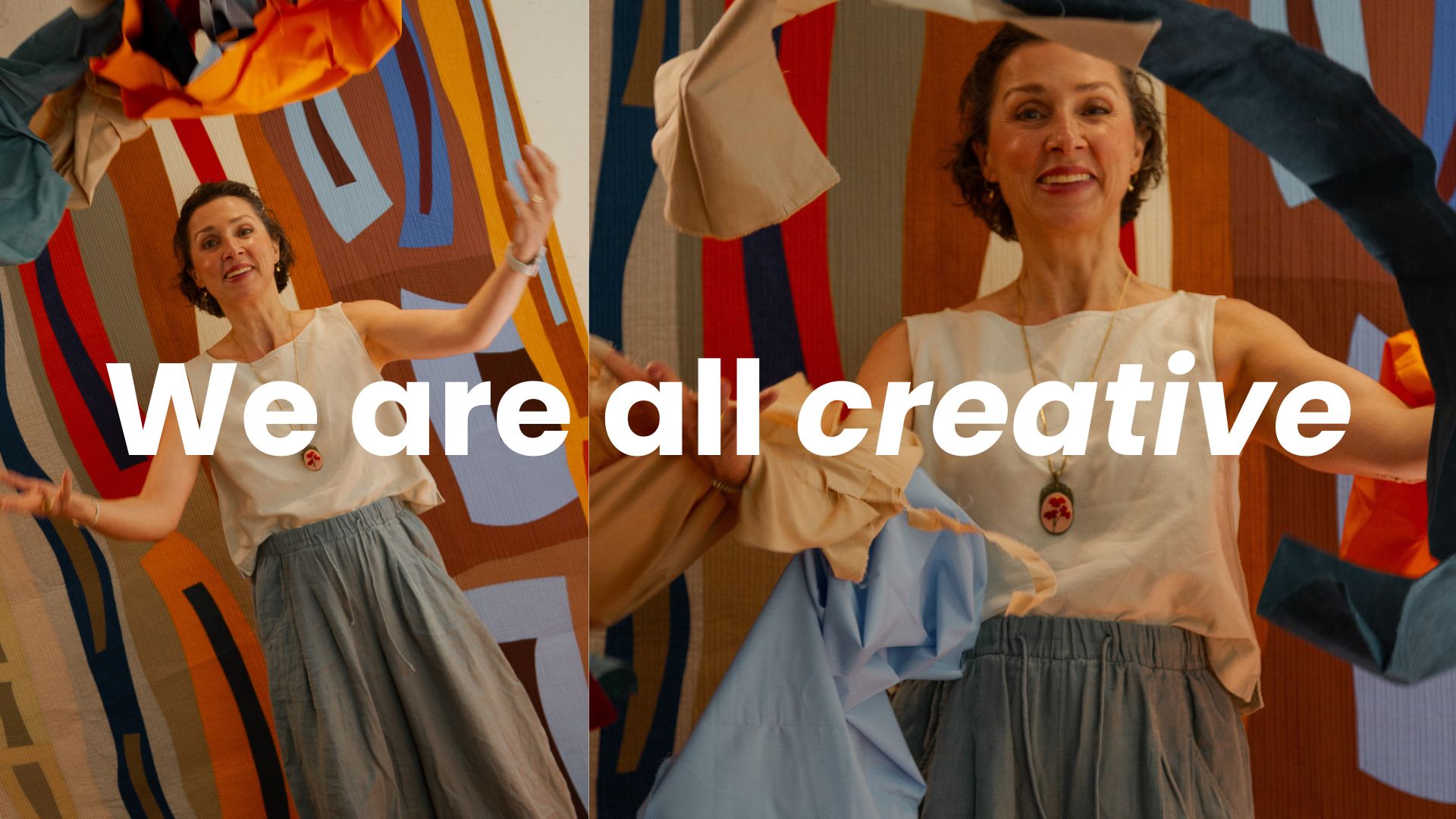
I have been carrying this tagline for years: WE ARE ALL CREATIVE. I say it in workshops. I write it on my website. I say it to students who sit down for the first time in front of a design wall and tell me, with complete certainty, that they are not creative people.
But I have been thinking lately about what those three words actually mean — not as a slogan, but as a claim. A real one. Because the more I teach and the more I make, the more I believe it is not just an encouraging phrase. It is a description of something true about what we are as human beings.
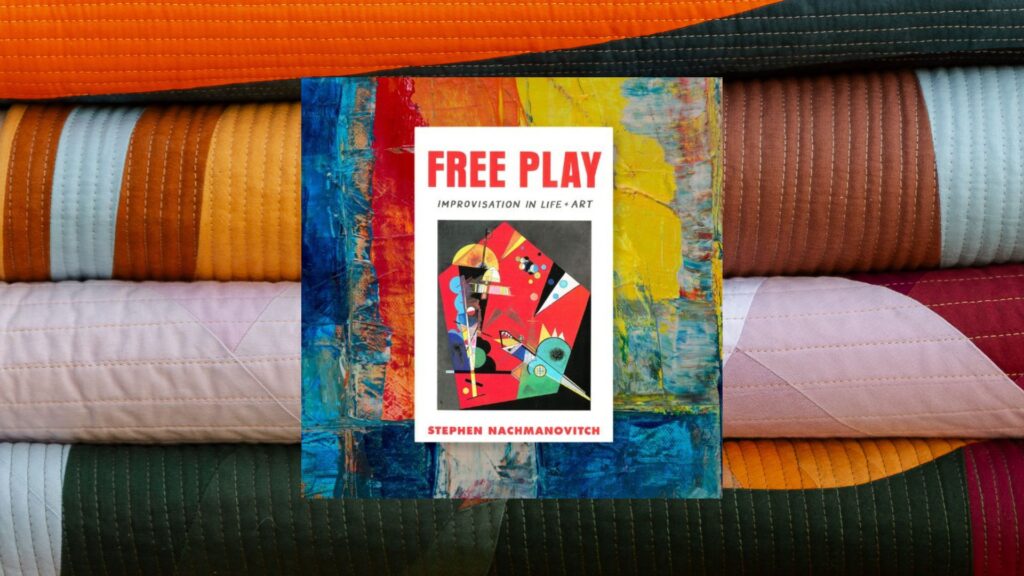
And the most precise, most illuminating exploration of that truth I have ever read is not a quilting book. It is Free Play: Improvisation in Life and Art by Stephen Nachmanovitch — a book that, since the first time I read it, has shaped how I understand creativity, improvisation, and what it means to make something from nothing.
What Nachmanovitch Means by Free Play
Nachmanovitch is an improvisational violinist who has spent his life performing and teaching at the intersection of music, philosophy, and the creative process. His book, first published in 1990 and reissued in a new edition in 2024, has become a classic — an international bestseller that artists, musicians, writers, and makers of all kinds return to again and again.
His central argument is radical in its simplicity. Free play is more than improvisation — it is the essence of our being, something we were born with and then spend our lives trying to recapture. Creativity, in his view, is not a talent distributed unevenly among a lucky few. It is not a skill reserved for professional artists. It is the essence of all our natural, spontaneous interactions. Every conversation we have is unrehearsed. Every meal we cook involves improvisation. Every time we solve a problem, navigate a relationship, or find our way through an unexpected situation, we are creating.
This is exactly what I mean when I say WE ARE ALL CREATIVE. Not that everyone is an artist in the professional sense. But that creativity — the capacity to generate something new from what we have, in the moment we are in — is not optional. It is built into us. Improvisation and creativity are not the property of a few professional artists or scientists but the essence of all our natural, spontaneous interactions.
Structure Ignites Spontaneity
One of the most quoted lines from Nachmanovitch is also one of the most misunderstood: Structure ignites spontaneity. For anyone who has ever been told that improvisation means working without rules, without plans, without any kind of structure, this idea comes as a surprise.
But it is something I have known intuitively in my own quilting practice for a long time. When I work improvisationally, I am not working randomly. I am working within a set of conditions I have chosen — a palette, a format, a scale, a way of cutting or placing fabric. Those conditions are not the enemy of freedom. They are the container that makes freedom possible.
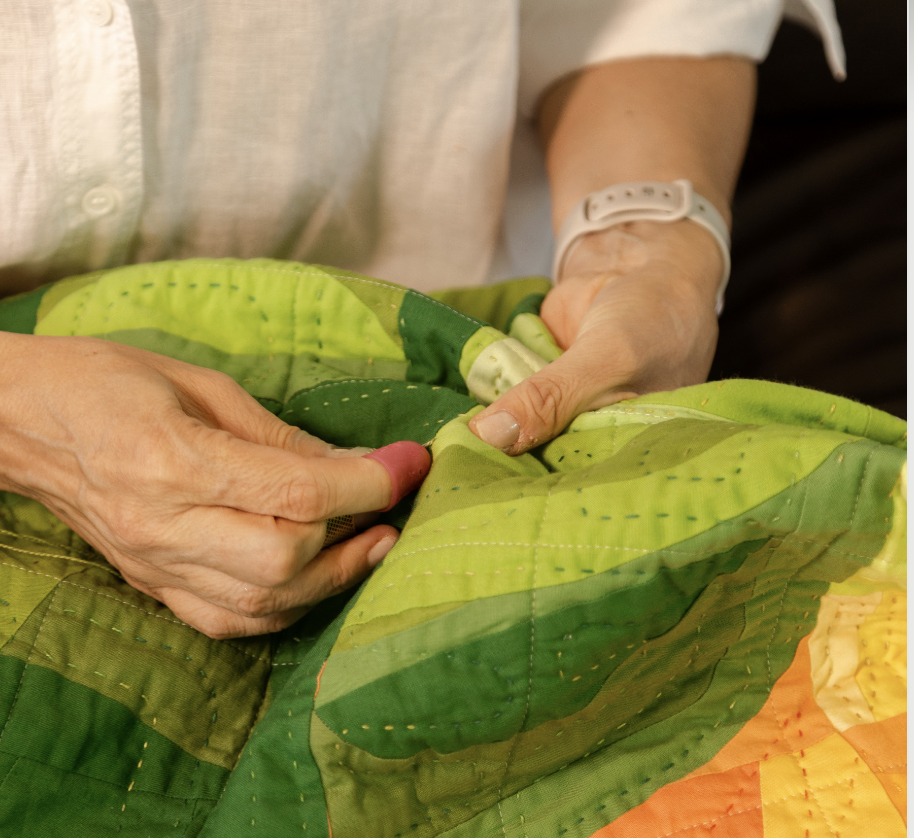
This is also what I discovered through my engineering training, long before I became a quilter. Constraints are not limitations on design — they are the parameters that define the space where design actually happens. Without the bridge’s weight limit, there is no bridge. Without the palette’s boundaries, there is no composition. Structure ignites spontaneity is not a contradiction. It is a precise description of how creative work actually functions.
Nachmanovitch makes the same point from a musician’s perspective: the rules of harmony and rhythm that a jazz improviser has internalized are not what restrict the performance. They are what makes the performance possible at all. The deeper the structure is absorbed, the freer the improvisation can be.
The Inner Critic and the Judging Spectre
One of the most powerful sections of Free Play deals with what Nachmanovitch calls the judging spectre — the inner voice that evaluates, criticizes, and second-guesses every creative choice before it can be made. Every quilter I have ever taught knows this voice intimately.
It is the voice that says that color is wrong before the fabric has even touched the design wall. It is the voice that compares the work in progress to an imagined finished piece and finds it lacking. It is the voice that asks, before a single cut is made, but what if it doesn’t work?
Nachmanovitch’s insight is that this voice is not a sign of incompetence or lack of talent. It is a sign that we care. The judging spectre appears because the work matters to us. And the solution is not to silence it permanently — which is impossible — but to learn to keep it in its proper place. To let it speak after the work is done, not before and during it.
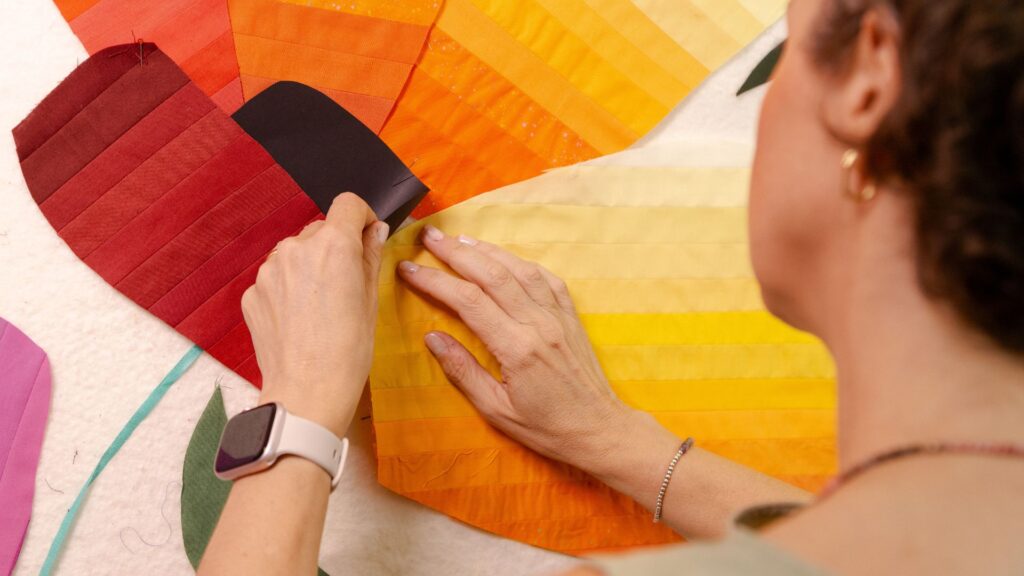
This is something I try to teach in my improv quilting workshops. The design wall is not a place for judgment. It is a place for proposals. You put something up, you look, you respond. The evaluation comes later. The making comes first. When students learn to separate those two modes — the making mode and the judging mode — everything opens up.
Mistakes as Ornaments
Another idea from Nachmanovitch that resonates deeply with my practice is his concept of mistakes as ornaments. He writes that if we know that the inevitable setbacks and frustrations are phases of the natural cycle of creative processes, if we know that our obstacles can become our ornaments, we can persevere and bring our desires to fruition.
In improvisation — in music and in quilting — there is no such thing as a mistake that cannot be integrated. A cut that goes wrong becomes a new shape. A color that clashes becomes a starting point for a new conversation. A piece that does not work as planned teaches you something that no successful piece could have taught you.
I think about this often when I am working improvisationally. The moment something unexpected happens on the design wall is often the most interesting moment in the whole process. Not because I planned it, but because I did not. The surprise is the signal that something real is happening — something that came from the work itself rather than from my original intention.
This is related to something Nachmanovitch writes that I find haunting and completely true: For art to appear, we have to disappear. The work that carries the most life is not the work that most perfectly executes a predetermined plan. It is the work that surprised its maker.
Original Nature and Authentic Voice
Toward the end of Free Play, Nachmanovitch writes something that I think about every time I stand in front of a design wall, and every time I watch a student discover something new about how they see color or place shape. He writes that everything we do carries the signature of our original nature — our handwriting, the vibrato of our voice, our way of using language, the look in our eyes — all of these things are expressions of who we fundamentally are, underneath all the techniques we have learned and the influences we have absorbed.
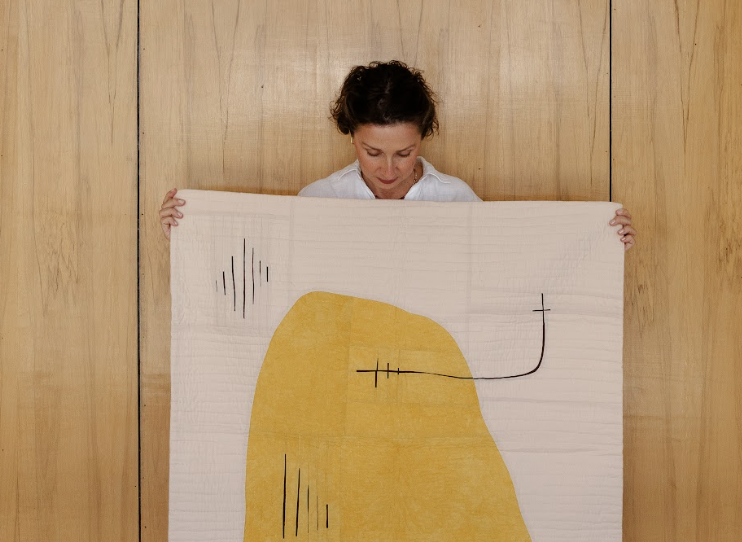
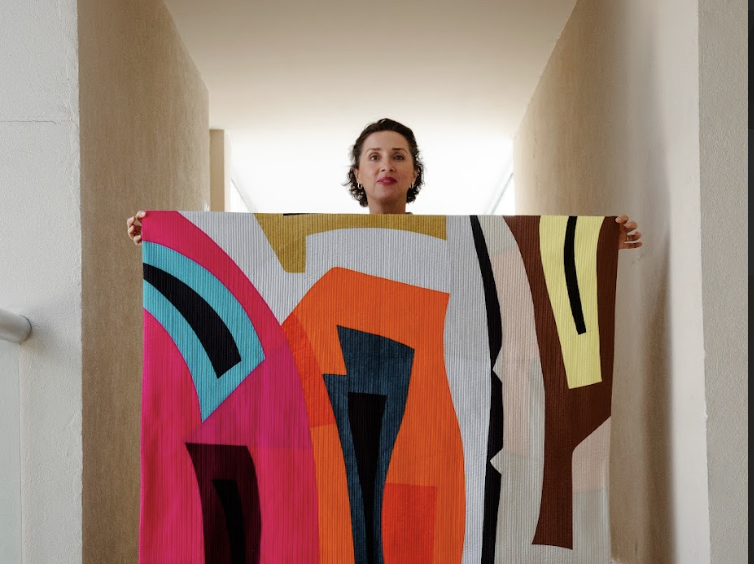
This is what creative voice means to me. Not a style that you decide on and then execute. Not an aesthetic position you adopt from what you admire in others. It is something that already exists in you, waiting to be expressed — and the work of a creative life is not to invent it, but to uncover it. To remove the layers of what you think you should make, until what remains is what only you could make.
I see this happen in my students regularly. There is always a moment — sometimes in the first workshop, sometimes after years of practice — when something on the design wall is unmistakably theirs. Not mine, not influenced by what they saw last month at an exhibition, not what they thought modern quilting was supposed to look like. Just theirs. That moment is the one I work toward as a teacher, every single time.
The Only Techniques That Can Help Us
Nachmanovitch makes one more claim in Free Play that I want to address directly, because it is perhaps the most radical of all: ultimately, the only techniques that can help us are those we invent ourselves.
I teach techniques. Color theory, improv cutting, value composition, how to build a palette, how to use the design wall. All of these things are useful. All of them open doors. But Nachmanovitch is pointing at something beyond technique — at the moment when the techniques you have learned are so fully absorbed that they disappear, and what remains is simply your own way of seeing and making.
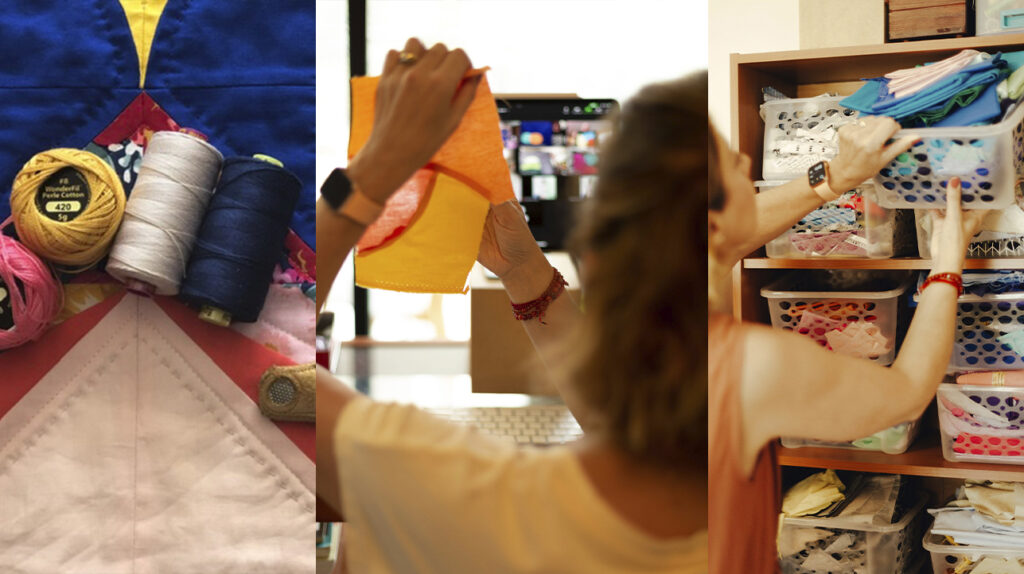
This is the horizon I am always working toward, both in my own practice and in what I try to offer my students. Not the accumulation of more methods, but the internalization of the ones that resonate most deeply — until they stop being techniques you apply and start being ways you naturally think. Until the structure, as Nachmanovitch says, truly ignites spontaneity.
That is what WE ARE ALL CREATIVE means to me, in its fullest sense. Not that making art is easy, or that talent is evenly distributed, or that anyone can do anything without practice and commitment. But that the impulse to make, to respond, to create something new in each present moment — that impulse is not a gift given to some and withheld from others. It is what we are. It has always been what we are.
The work is to trust it.
Read the Book
If you have not read Free Play, I encourage you to find a copy. A new edition was published in 2024 with a foreword by Ruth Ozeki and an afterword by Nachmanovitch himself. It is not a quilting book. It is not even primarily a visual art book. But it is the most honest, most precise, most beautiful exploration of what it means to make something that I have ever read. Wherever you are in your creative practice — beginning, returning, stuck, flourishing — it will meet you there.
You can find it on Amazon or at your local bookshop.