


Writing an artist statement for your quilt is one of the most avoided tasks in a quilter’s process. It’s also one of the most consequential. A juror stands in front of your quilt for somewhere between five and fifteen seconds — that’s the window most viewers give a piece of art before moving on. Your quilt does the heavy lifting in that time, sure. But the small paragraph next to it, the one you probably wrote in a rush the night before a deadline, is doing more work than you think.
I’ve written dozens of artist statements over the years: for my website, for catalogs. The first draft is still painful every single time. That’s normal, and I’ve stopped expecting it to feel easy. What you don’t need is to sound like a robot, or like an art history professor who’s never actually touched fabric. A good statement sounds like you, thinking out loud, with the extra words cut.

Why the Statement Matters as Much as the Quilt
An artist statement isn’t paperwork. It’s the only place you get to speak directly to someone who can’t ask you questions. Studio Art Quilt Associates, the most respected organization in our field for exhibition standards, describes it as a way to extend the dialogue your piece has already started visually, giving the viewer a way to connect it to their own thoughts and emotions.
That’s exactly how I think about it. My quilts start as something felt in my chest, long before they become something I can explain. But the explaining still matters. A statement that adds nothing to what the viewer already sees isn’t worth writing, and a juror notices the difference between a piece with real thinking behind it and one without.
This is also, practically, how you get into shows. Treat the statement as part of a cohesive application alongside your portfolio and resume. It’s not an afterthought tacked onto the end of the process, even if it often gets treated that way.

The Three Statements You Actually Need
One of the most useful things I learned from SAQA’s own writing guidance is that “artist statement” is not one document — it is three, and quilters routinely try to force all three into one, which is why so many statements feel bloated and vague.
- The piece statement— a few sentences about one specific quilt, written for a juror or a wall label. Many SAQA global exhibitions cap this around 125 words, so economy matters
- The body-of-work statement — two to three paragraphs introducing a series or a themed exhibition entry.
- The long-form statement — the one on your website, describing who you are, what you make, and why. This one can run longer, but even SAQA recommends keeping it under five paragraphs.
Confusing these three is the single most common mistake I see. If you’re applying to a show, you need statement #1, tight and specific to that quilt — not a condensed version of your whole artistic philosophy.
What Makes a Statement Sound Like a Robot
A few patterns show up again and again in weak statements, in painting and photography just as much as quilting.
Jargon standing in for actual thought is the biggest one. Advises using artistic terms carefully and staying away from language that sounds “artsy” for its own sake. My rule of thumb: if a word wouldn’t survive you saying it out loud to a friend in your studio, it doesn’t belong in the statement either.
Then there are extreme binaries. The Creative Independent’s widely cited points out how often statements lean on empty opposites — work that’s supposedly “both delicate and bold,” or “exploring the boundary between chaos and order.” These phrases feel meaningful right up until you notice that almost any quilt could claim them. Specificity is what makes a statement actually yours instead of interchangeable with someone else’s.

A third: confusing biography with statement. Your statement isn’t your resume. A childhood memory of your grandmother’s sewing machine might be true and lovely, but unless it directly explains a choice in the piece someone’s looking at, it belongs in your bio, not here.
And last, writing for art historians instead of people. Most viewers of your quilt, jurors included, aren’t scholars. They’re people who go to museums now and then. Writing like it’s headed for a peer-reviewed journal creates distance instead of connection.
How I Actually Write One
Here is the process that works for me, quilt after quilt:
- Start by overwriting. Write everything — the memory, the color choices, the technique, the feeling in your chest when you finished piecing it. Don’t edit yet. You need raw material before you can find the real statement hiding inside it.
- Read it out loud. This is the fastest way to catch what doesn’t sound like you. If a sentence makes you cringe when spoken aloud, cut it.
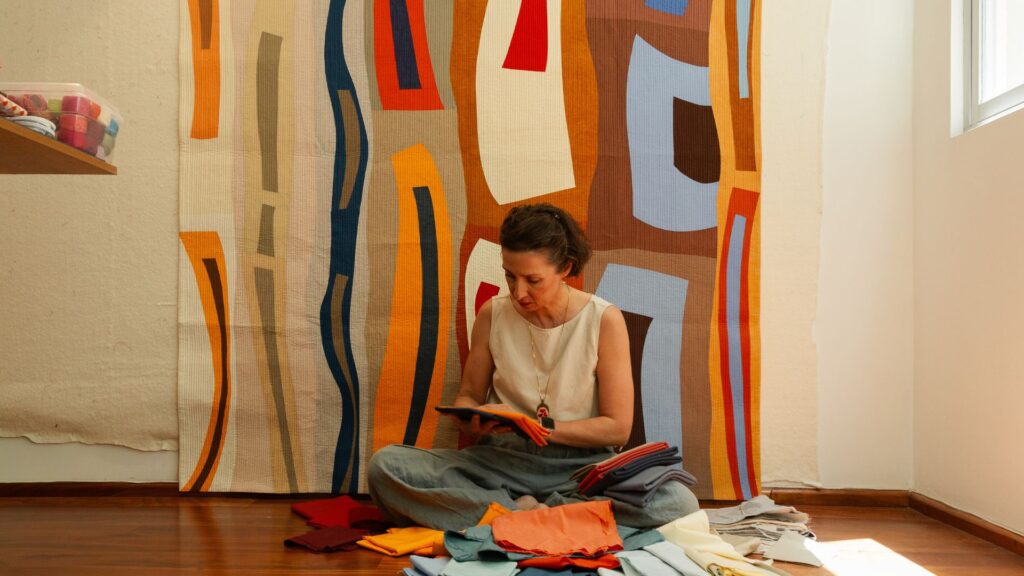
- Cut until only the heartbeat is left. For my quilt Casagrande, the first draft of the statement was three times longer than what I eventually submitted. What stayed was the specific tension the piece was actually about: the warmth of the flowers I remembered from São Paulo against the cool, structured blue of the city I’d left behind. Everything else — my full biography, my full color theory explanation — belonged somewhere else, not in that paragraph.
- Answer one real question, not five. What is this piece actually about, underneath the technique? Not “what inspired you” in the vague sense — the specific tension, memory, or idea the piece is wrestling with. Every other sentence should serve that one answer.
- Say why this medium, specifically. Why fabric and thread, and not paint or clay? For me, the answer is structural — my engineering background means I think in units, seams, and construction even when the subject is entirely emotional. It’s often the most distinctive line you can write, because it’s the one no other artist can say the exact same way you can.
First Person, Always (Mostly)
Write as “I,” not “the artist.” It sounds like a small stylistic choice, but it changes the entire tone of the piece — first person invites the reader in, while third person holds them at arm’s length. SAQA’s own guidance for members is direct on this point: use first person to welcome the viewer into your world, and save third person only for the rare submission form that specifically requires it.
This is also why a statement is never really finished. The one on your website today should sound a little different from the one you wrote two years ago, because your understanding of your own work keeps developing. I revise my long-form statement every year or so, not because the old one was wrong, but because I keep seeing my own quilts more clearly the longer I make them. Keep old drafts. You will want to see how your thinking has moved.
Vulnerability Is Part of the Job
Writing honestly about your own work is uncomfortable in a specific way that making the work usually isn’t. I’ve written before about the emotional risk that comes with making art— the statement is where that risk becomes literal, because now you have to name, in plain language, what you were only willing to say in fabric. That discomfort is a sign you’re writing something true, not a sign you’re doing it wrong.
It also connects to something I believe strongly: that creativity is not a rare gift but a basic human capacity, and that art is intentional communication, not decoration. Your statement is where that intention gets to speak in words instead of stitches. Treat it with the same care you gave the piecing.

A Working Checklist
Before you submit:
- Have you picked the *right kind* of statement — piece, body-of-work, or long-form — for what’s actually being asked?
- Is it under the word count the prospectus specifies? (Many juried shows enforce this strictly.)
- Does every sentence say something only this piece could say?
- Did you read it out loud, and does it still sound like you?
- Have you cut every phrase you wouldn’t actually say to a friend standing in front of the quilt?
If your quilt is heading toward a juried show this year, my post on [preparing a quilt for exhibition, from concept to submission](https://carolinaoneto.com/how-to-prepare-a-quilt-for-exhibition-from-concept-to-submission/) walks through the rest of the process — photography, sizing, paperwork, timing — so the statement isn’t the only piece left to figure out at the last minute.
I still have the first artist statement I ever wrote, saved in an old folder somewhere. It’s overwritten, apologetic, and about three times too long. I keep it around anyway, mostly as proof of how much this actually improves with practice. What’s yours look like — the first one, not the one you’d submit now?