


Knowing how to care for an art quilt is one of the things people ask me about after they decide to bring one home, and it is a fair question. A quilt on the wall is a textile, and textiles respond to light, dust, humidity and gravity in ways a painting on canvas does not. I am an artist, not a conservator, so I didn’t want to answer from my own habits alone. I went to museums and conservation sources and gathered what they agree on, and I’ve noted the places where they differ.

Start With How It Hangs
The most consistent advice across the sources I read is about what not to do. Don’t put nails, pins, staples or tacks through a quilt. The University of Nebraska–Lincoln Extension guide to storing and displaying quilts explains why: they concentrate stress in tiny areas, which can break threads and leave rust spots.
What you want instead is a method that spreads the quilt’s weight across its full width. There are two common ones.

A sleeve. A fabric tube sewn to the back of the top edge, with a rod or slat slid through it. The UNL guide recommends a casing made of a double layer of fabric so the rod never touches the quilt itself. For exhibition work, the SAQA guidelines ask for a sleeve about 4 to 5 inches (10 to 13 cm) wide after sewing, with a little ease so the rod doesn’t show as a bump from the front.
Hook-and-loop tape. The Canadian Conservation Institute’s basic care guidance for quilts describes stitching the loop side of the fastener to cotton tape, hand-stitching the tape to the top edge of the quilt, and attaching the hook side to a sealed wood batten on the wall. Winterthur Museum’s textile conservation tips describe a similar approach for quilts and tapestries.
Either way, the point is the same: the quilt’s weight should be carried by something that was designed to carry it, and nothing should be pushed through the cloth.
In my own studio, I always sew a hanging sleeve onto the back of every quilt, so it is ready to hang when it leaves me. Depending on the finish, the edge of the quilt has either a binding or a facing. I also make a label for each one, with the title of the quilt, the date I finished it, my name and signature, and the place where it was made. If you are buying a quilt from anyone, the sleeve and the label are two things worth looking for.
Where It Hangs Matters as Much as How
Light is the biggest long-term risk. The San Jose Museum of Quilts & Textiles quilt care guide points out that both direct sunlight and fluorescent lighting emit ultraviolet radiation that can fade colors and weaken fibers over time. The Canadian Conservation Institute adds that light damage is cumulative and can’t be reversed. That doesn’t mean a quilt has to live in the dark. It means choosing the wall carefully:
- If you can, hang it so the middle sits at about eye level. The San Jose museum suggests roughly 5 to 5½ feet (1.5 to 1.7 m) from the floor.
- Avoid direct sun, and avoid rooms that are brightly lit most of the day. Winterthur suggests UV filters on windows where sun can’t be avoided.
- Avoid outside walls, which can be damp and change temperature, and keep quilts away from radiators, heating vents and fireplaces.
- Avoid kitchens, where grease and steam are a problem.

A quilt that is hung beautifully and then left for years in the same spot will still age. Two sources suggest giving it a rest. The UNL guide recommends taking a displayed quilt down at least every six months to rest the fibers, and the San Jose museum suggests rotating every few months, ideally by alternating between two quilts. If you only own one, the Canadian Conservation Institute’s suggestion is to alternate display with periods in storage.
Temperature and Humidity
Here the sources give different numbers, so I would treat them as a range and not a rule. The UNL guide describes ideal conditions as a constant 10 to 16°C with around 50 percent relative humidity, while acknowledging that most private collectors can’t match that. The San Jose museum suggests 17 to 22°C and 45 to 55 percent relative humidity, which is much closer to an ordinary home. The Canadian Conservation Institute gives no figures, but stresses that severe or rapid changes in temperature and humidity make fibers swell and shrink, and that high humidity can lead to mold.
What they all agree on is that stability is the goal. A steady room is better than one that swings from warm to cold, or from damp to dry.

Keeping It Clean
Dust is the everyday enemy. Dust attracts insects and moisture, and over time it can work its way into the cloth. The gentlest approach in the sources I read is this: lay a piece of fiberglass screen (the Canadian Conservation Institute and Winterthur both suggest it) or cheesecloth (the San Jose museum) over the quilt, and use a hand-held vacuum on the lowest suction. Lift and move the nozzle rather than rubbing, and avoid brush attachments.
Washing is a different matter. The San Jose museum’s advice is simple: “When in doubt, don’t clean it.” Many everyday cotton bed quilts can be washed, but an art quilt is a different object, and the sources are consistent that wet cleaning of anything valuable is a job for a textile conservator. The Canadian Conservation Institute also says to avoid the washing machine and dryer for these pieces.
If a quilt does get a stain or a spill, I would contact the artist or a conservator before doing anything yourself.
Storing It Between Displays
When a quilt is off the wall, the preferred method in the sources I read is to roll it. The Canadian Conservation Institute recommends a tube at least 15 cm in diameter, and the UNL guide and the San Jose museum both say at least 4 inches (10 cm). The tube should be padded and covered with acid-free tissue or washed, unbleached cotton muslin, and the quilt rolled loosely, without wrinkles. The rolled quilt can then be wrapped in prewashed, unbleached muslin or clean cotton sheeting. This is also how I store my own quilts, rolled on a tube, so they don’t pick up creases and marks.
If a quilt has to be folded, fold it as few times as possible, pad the folds with acid-free tissue, and refold it regularly so the stress doesn’t sit in the same place. Don’t stack heavy things on top of it.
A few more points come up in nearly every source:
- Don’t store a quilt in a plastic bag. Plastic traps moisture, which can lead to mildew. The UNL guide adds that it attracts dust through static.
- Avoid attics, basements, kitchens and other unheated spaces, where temperature and humidity change too much. Winterthur suggests a bedroom as a good option.
- Skip mothballs. The San Jose museum notes that their active ingredient is harmful to people.
- If a quilt has wool in it, check it from time to time. The Canadian Conservation Institute says wool attracts insects, and describes small round holes, larvae or webbing as signs to look for.
A Short Checklist
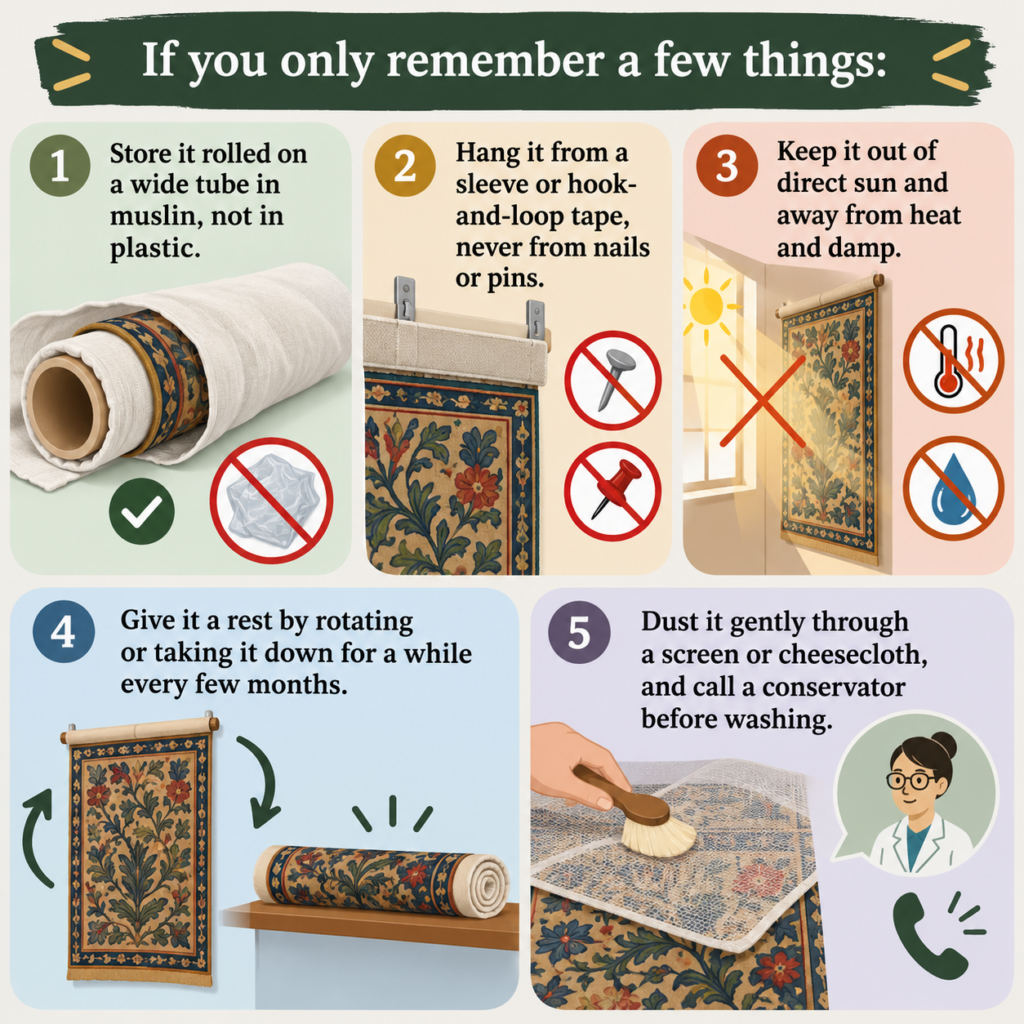
If you only remember a few things:
- Store it rolled on a wide tube in muslin, not in plastic.
- Hang it from a sleeve or hook-and-loop tape, never from nails or pins.
- Keep it out of direct sun and away from heat and damp.
- Give it a rest by rotating or taking it down for a while every few months.
- Dust it gently through a screen or cheesecloth, and call a conservator before washing.
If You’re Thinking of Bringing One Home
Everything above applies to any textile, and it is meant to take some of the worry out of owning a quilt. A well-cared-for quilt can hang in a home for many years. If you would like to see which originals I currently have available, my shop includes pieces such as Refraction and Imaginary Places II. And if you are an artist preparing your own work for a show, my post on preparing a quilt for exhibition covers the practical side of sleeves and submissions.
I’m curious how you display your quilts at home. Do you have a favorite wall for them, or a way of hanging that has worked well for you?