

How to price an art quilt is a question I get from two kinds of people: artists who are about to sell their first piece, and buyers who see a price and want to understand it. They are really asking the same thing from opposite sides. What is in that number? I don’t have a formula, and after reading what other artists, SAQA and galleries have written, I’m not sure anyone does. What I can do is tell you what goes into my own prices and share what I found when I looked for outside references.

What Goes Into My Prices
When I price a quilt, I think about six things: the fabrics, the time, the difficulty, the size, the density of the quilting and, less obviously, when the quilt was made.
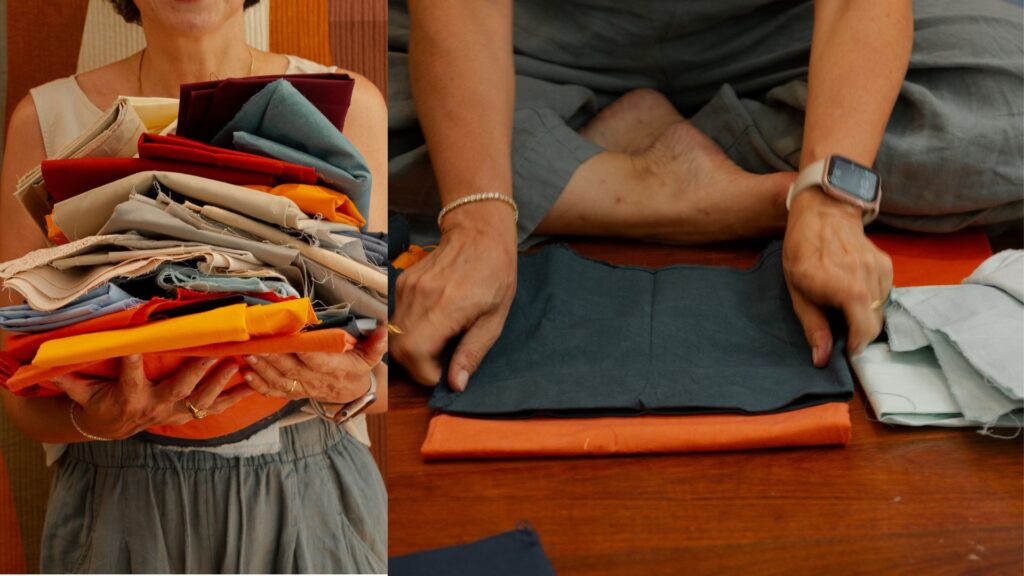
Fabrics. Every quilt starts with materials, and for a large piece that is a real cost.
Time. A quilt can take a very long time from the first idea to the last stitch, and that time is part of what you are buying.
Difficulty. Some pieces are simply harder to make than others, whether because of how the shapes are built, how many pieces there are, or how much has to be right for the whole thing to work.
Size. A bigger quilt needs more fabric, more time on the wall and more quilting.
Quilting density. The closer together the lines of stitching, the more hours at the machine. A densely quilted piece is a very different amount of work than a lightly quilted one of the same size.
When it was made. My newer work is priced higher than quilts I made ten years ago. The reason is my expertise: the knowledge and the years of practice I bring to a piece today are part of what is in it, and I think they belong in the price.
I list them separately because they don’t always move together. A small quilt can be harder than a large one. A very simple composition can still be densely quilted. None of the six is a number I can plug into an equation. They are the things I weigh.
What the Outside Sources Say
I wanted to know how my approach compares, so I looked at what SAQA and gallery sources recommend. A few things stood out.
There is no single method. In SAQA’s piece on strategies for pricing your artwork, Elizabeth Van Schaick gathers advice from several fiber artists, and one of them describes a “huge inconsistent range” in how artists price. The two methods that come up most are an hourly approach (choose a wage, multiply by the hours, add materials) and a price per square foot. SAQA’s page on methods of pricing walks through both.
The numbers vary a great deal. One SAQA page gives an average range of $150 to $250 per square foot. In Judith Trager’s article, a SAQA professional artist member suggests starting at $50 to $75 per square foot for large quilts and $100 to $125 for small ones, and says she herself works from a base nearer $300 retail, adjusted for exhibition history, complexity and other factors. These pages aren’t dated, so the figures may be old, and I wouldn’t use any of them as a rule. I’m quoting them to show how wide the range is. Trager’s central point is one I found useful: “Art has no fixed value.”

Costs are not the same as value. A 2026 guide to prices from the gallery software company Artlogic says it plainly: materials and production costs matter, “but they are not the same thing as market value.” Galleries also look at the artist’s career stage, exhibition history and where a piece sits in a body of work. A quilt from an important series, or one that has been in a major exhibition, can be priced differently from an otherwise similar quilt made last month.
I find this helpful because it explains why the things I weigh are only part of the picture. The sources also treat an artist’s growing experience as a reason prices rise over time, which matches how I think about my newer work. The same sources say time and materials set a floor, and the market and the artist’s track record shape what sits above it.
Where and How a Quilt Is Shown
The same quilt can read differently depending on where it hangs. Van Schaick’s article notes that location and clientele shape how a piece is valued, and that a juried fair or a prominent gallery can support a higher price than an informal setting. Her advice for informal settings is to show work already priced for that audience instead of cutting prices.
Trager raises a related point about presentation. She lists unprofessional presentation among the common mistakes: work should be finished, ready to hang and professionally photographed. She also says price itself is part of how a buyer sees the work, and that pricing it like craft-fair merchandise makes it look like exactly that. “If you value your artwork, so will they,” she writes. I think about that whenever I’m tempted to underprice a piece I’m nervous about.
Consistency Matters
One piece of advice shows up in every source: be consistent. Artlogic recommends the same price everywhere a piece is shown, whether that is a gallery, a fair or a website. Trager sells at the same retail price to everyone, including friends and family. In the SAQA article, one artist is blunt about it: never discount the retail price for anyone, “not even your own mother.” If you want to give something to someone, the sources suggest donating work instead of discounting it.
The reason is practical as well as principled. Artlogic notes that discounting can close one sale, but repeated discounts can damage an artist’s wider market.
If a Gallery Is Involved
Galleries and shops take a share of the sale. The SAQA article says galleries and venues typically take 20 to 50 percent, and Artlogic describes a roughly 50/50 split as common. Trager adds that galleries and museum shops often buy at wholesale, which can be up to 50 percent below retail. The practical lesson is to build the commission into the price from the beginning. The SAQA example is that an artist who wants to keep $600 after a 30 percent commission needs an asking price of about $860. Raising your price later to cover a commission is much harder than pricing for it from the start.
Raising Prices Over Time
Both the SAQA article and Artlogic suggest that prices should rise gradually. Van Schaick’s source suggests something like 5 to 10 percent a year over two or three years, rather than one large jump, and notes that awards, teaching, commissions and publicity can all support a higher price. Artlogic says increases should follow real market development, and warns that moving too fast can put the next body of work out of reach of the artist’s current collectors.
The other side of that advice is a warning about underpricing. Trager describes a solo show where nothing sold, and decided that the work had been underpriced, not that it was weak. Another artist in the SAQA article puts it this way: “If everything you make sells immediately you are probably under priced.” I find both of these comforting, because they treat a price as something you can adjust as you learn.
If You’re on the Buying Side
If you’re looking at an art quilt and wondering whether the price is fair, here is how I would read it. The number reflects the materials, the many hours of cutting, piecing and quilting, the difficulty of the piece and the artist’s track record. It is also the price that a gallery, a show or a private buyer would see, which is why it stays the same for everyone.
If you’d like to see how this looks in practice, some of the originals in my shop include Refraction and Imaginary Places II.
Where I’ve Landed
I’m still learning how to price my own work, and I expect to keep adjusting. What stays with me from this reading is that fabric and hours alone leave out what the sources keep pointing to: the market, the series, the exhibition history and the artist’s own sense of value.
If you are an artist who sells your work, how do you decide on a price? And if you are a collector, what would help you understand it better?