

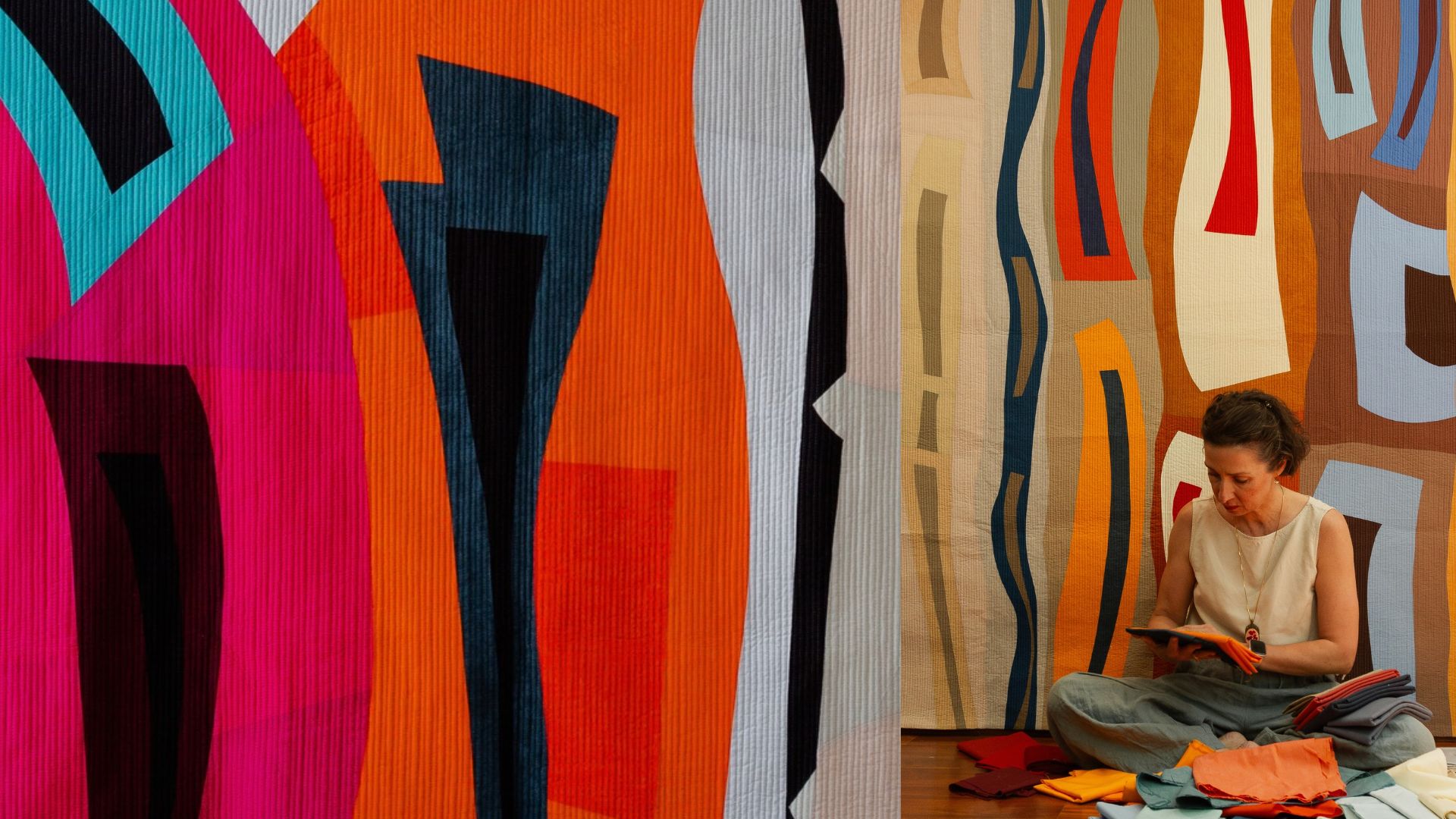
Working in a quilt series is something I understood in theory long before I could see it in my own work. I wrote about the benefits of working in series a while ago, and everything in that post still holds for me. But a list of benefits looks very different from three actual quilts side by side, and that is what I want to look at here: The Space Between I, II and III, and what I can see in them now.
It Started as an Exercise
This series began as an exercise, and really as an experiment. I wanted to understand figure and ground better: how what we read as a figure and what we read as ground can change depending on the color around it. I was curious how playing with value, saturation or temperature could make a shape advance or recede, and how all of that interferes with the shapes themselves. I’ve written about figure-ground through the lens of Gestalt theory in Understanding Figure-Ground in Quilt Design: A Gestalt Theory Approach for Quilters, and these quilts are where I’ve been testing that theory in fabric.
The title comes from the same question. The space between one shape and another is not empty. It is part of the composition, and it can be as active as the shape beside it.

Three Quilts, Side by Side
The Space Between I is a square built from four panels. The palette is warm: reds, magentas, burgundy, orange, peach and cream, with a small touch of purple. Big curved arches overlap each other and push across the panel seams, so the eye keeps traveling from one quadrant to the next.
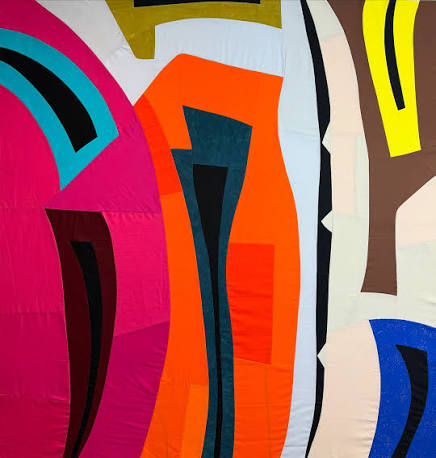
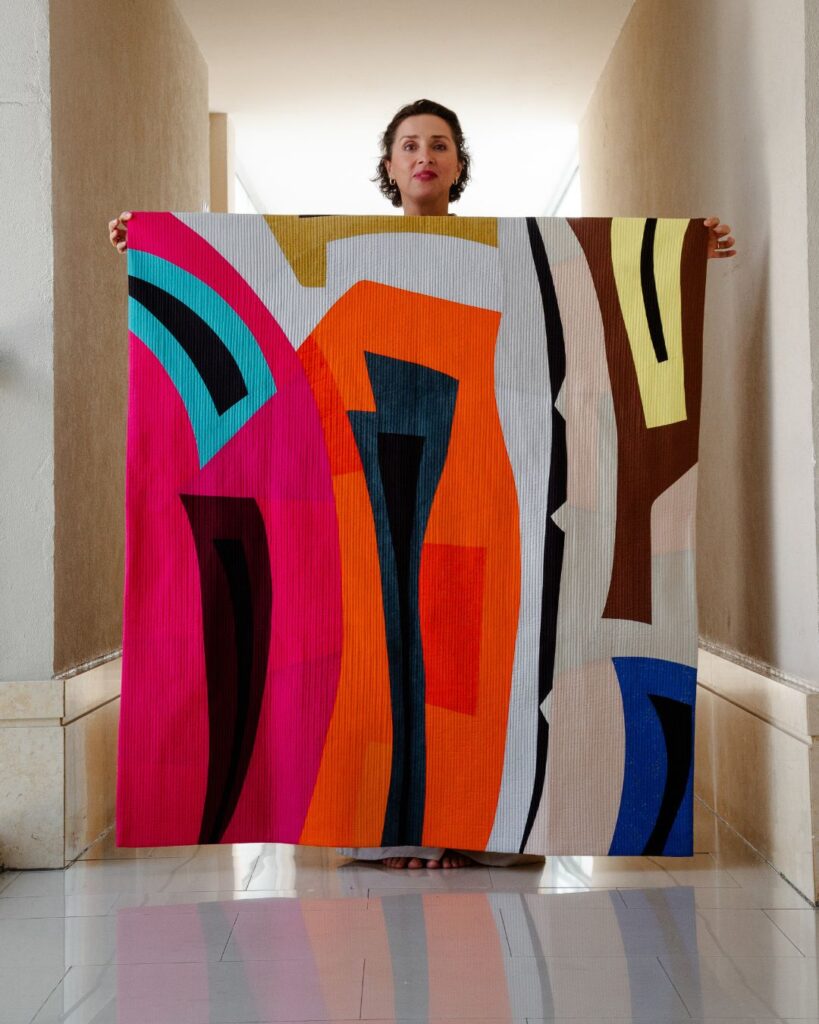
The Space Between II leaves the quadrants behind and turns vertical. A large pink arch sits on the left, a tall orange form rises through the middle with navy and teal tucked inside it, and a quiet grey ground holds everything while yellow, brown and cobalt blue show up toward the right. The shapes are taller and narrower than anything in the first quilt, and they taper.
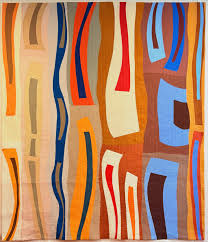
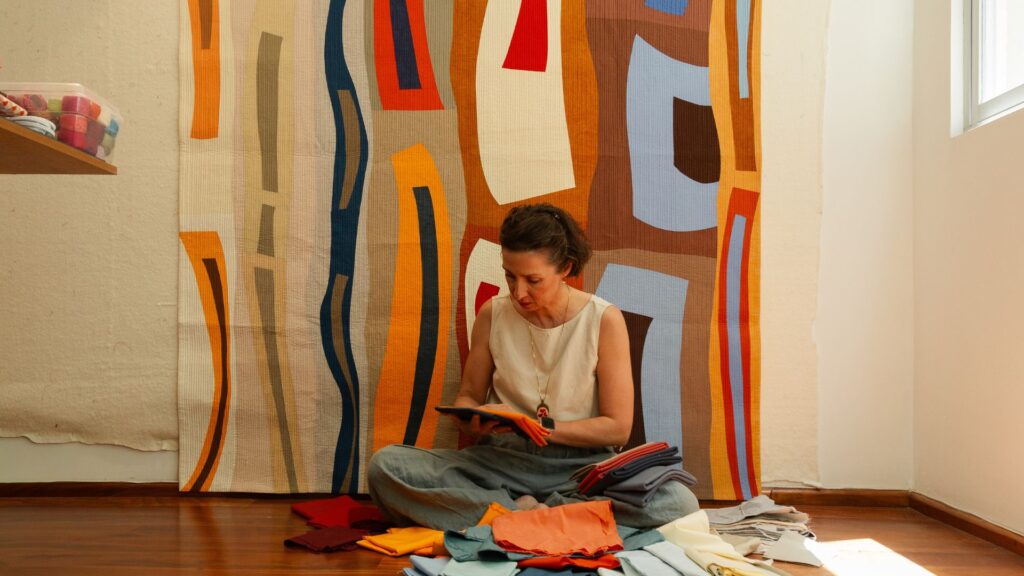
The Space Between III takes the vertical idea further. It is built from tall bands of cream, ochre, brown, terracotta, blue and grey, and slender looping shapes repeat across it in two rows, almost like a rhythm. The palette is earthier and quieter than the other two, and the loops do most of the talking.
What Stayed and What Moved
When I look at the three together, the thing that connects them is the shapes. Certain forms come back from quilt to quilt: the curved, tapering, looping shapes that open and close like arches. They get bigger, smaller, taller and narrower, but I recognize them every time.
What changed is the scale, the colors, and the structure. The first quilt is organized in four quadrants. The next two are not. The palette went from the hot, saturated reds and magentas of the first piece to the cooler blues and greys of the second and the earth tones of the third. The shapes got larger relative to the quilt, and the composition opened up.
I find this interesting because it shows how much freedom a few repeated shapes can give you. When some things stay steady, the others are free to change. I wrote about rules making you more creative earlier this year, and a series is one of the places where I feel that idea most clearly in my own work.
I’m not going to describe how I make these shapes. That belongs to my classes. What I want to write about here is what I can observe rather than how it’s done. If the curved, organic forms in these quilts are what caught your eye, that is the territory of two of my classes: Organic Shapes, where I teach working with rounded, organic forms, and Curves and Transparencies, where curves and color come together.
Staying With a Few Forms
Other artists have stayed with a small set of forms for a very long time. The Tate’s teaching materials on Giorgio Morandi note that he used the same simple elements, including bottles, boxes and the view from his window, and that one room of the exhibition traces how he rearranged the same objects across many paintings. I’m not comparing myself to Morandi. I just find it helpful to remember that returning to a few forms is a very old way of working, and that there is a lot of room for variation inside it.
Seeing the Series in Public
Two of these quilts have also gone out into the world, which gave me a new way of looking at them. The Space Between II was accepted into Quilt Visions 2026, which opens in late October at the Visions Museum of Textile Art in San Diego and runs into January 2027. The Space Between III was accepted into Quilt National 2027 at the Dairy Barn Arts Center in Athens, Ohio, my second time being part of Quilt National.
I’m glad to see two quilts from the same body of work in two different shows. It makes the series feel like part of a conversation, and I find that helpful when I’m deciding what to make next.
A Series Can Cross Over Into Another
I just finished quilting Anemos, which is a mixture of two of my bodies of work: my flowers series, which includes Casagrande and Seeds of Freedom, and the Space Between series.
On the floor of my studio, it’s a large radiating flower with a blue circle at its center. Petals of neon yellow, orange, red and coral fan out from it, and big green and teal leaf forms curl around them, all set against a soft peach and cream pieced ground. The flower is the subject. But the shapes you can see repeating all through the Space Between quilts come back here too.
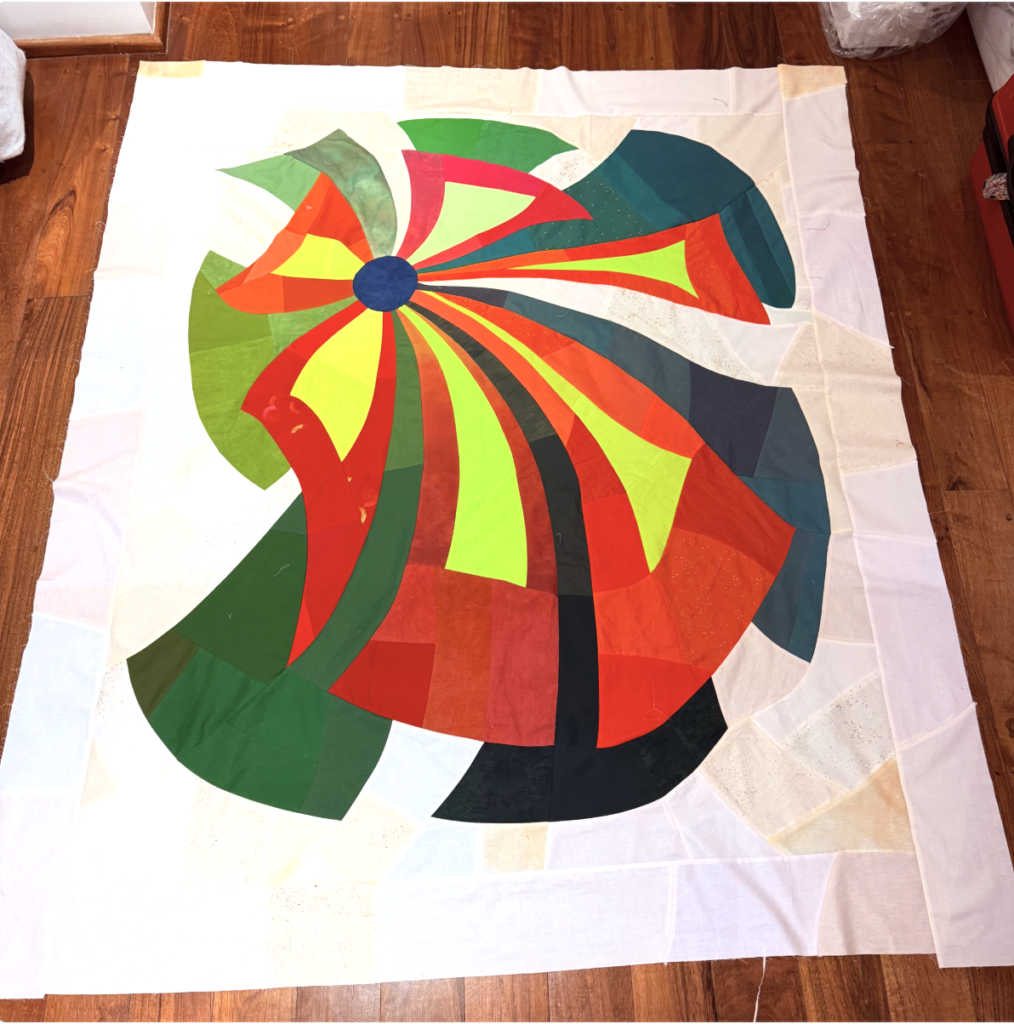
This is the first time I’ve arrived at a point where I’m mixing two series. In the flowers, I’m working with the idea of a flower. In the Space Between, I’ve been working with the space around and between shapes. In Anemos both ideas are in the same quilt, so I’m thinking about the petals and the leaves, and also about the space between them and inside the petals.
I like having one quilt that sits between two series. It reminds me that a series doesn’t have to be a closed box, and that two bodies of work can end up talking to each other.
Working in a Series at Clos Mirabel in 2028
Working in series is also going to be the focus of a retreat I’m planning for 2028 at Clos Mirabel, the same place near Pau in the French Pyrenees where I teach every August. I’m still putting the details together, so it isn’t listed yet. If you’d like to be among the first to hear when it opens, keep an eye on my website and my France retreat post for updates.
If you want a bigger picture of why this way of working is worth trying, my earlier post on the benefits of working in series covers it.
Have you ever noticed one of your quilts turning into two, or three? I’d love to hear which shapes you kept coming back to and what you couldn’t help changing.